
Updated · By Adventure Man
A field watch is a tough, legible, modestly sized wristwatch built to be read at a glance anywhere: a clean, high-contrast dial, luminous hands and markers, a durable case and a simple strap. The style grew out of the wristwatches soldiers wore in the First and Second World Wars, and today it is the everyday all-rounder of the watch world.
Some watches are made to be admired. A field watch is made to be used. It has one job: tell you the time, clearly, wherever you are, and keep doing it without asking for attention. That simplicity is why the style has lasted more than a century. The longer story starts in the trenches.

Where the field watch came from
The First World War: from pocket to wrist
Before 1914, most men carried a pocket watch. In the trenches that made no sense. Officers coordinating artillery and infantry needed to check the time instantly, with both hands busy, in mud, rain and darkness. Soldiers began strapping small watches to their wrists, often with a protective grille over the glass.
These "trench watches" set the pattern. They had large, clear numerals, luminous hands and dials so they could be read at night, and robust cases. Function decided every detail.
The Second World War: a standard emerges
By the Second World War, armies were issuing standardised wristwatches. The specifications were demanding and very similar from country to country: high contrast, clear numerals, luminous markings, a hacking seconds hand so troops could synchronise, a tough, water-resistant case and a strap that could survive anything.
The best-known British example is the group of watches collectors call the "Dirty Dozen": the W.W.W. ("waterproof wristlet watch"), made to a British military specification by twelve Swiss manufacturers and issued around the end of the war. Matt black dials, luminous hands and numerals, a small seconds hand, a shatter-resistant crystal. If you showed one to a soldier in 1945 and a field watch to someone today, both would recognise it.
After the war: from issue to icon
Military field watches were sold on as surplus, copied and refined, and gradually became civilian watches. Their appeal never really changed. They are easy to read, easy to wear and hard to break. Today "field watch" describes a design language as much as a job.
Hamilton, which calls its Khaki Field Mechanical a faithful recreation of a 1960s original, sums up the idea in one line:
"Inspired by the military, built to last, this is the original soldier’s watch."
Hamilton, Khaki Field Mechanical 38 product page
What makes a watch a field watch
There is no official checklist, but a true field watch usually has these features.
Legibility first
A clean dial with strong contrast and clearly marked hours. Hands that are easy to tell apart. If you have to look twice, it isn't a field watch.
Lume
Luminous material on the hands and markers so the watch works in the dark. Modern field watches use Super-LumiNova or similar, which charges in light and glows for hours.
The pigment behind it is a strontium aluminate phosphor. Nemoto & Co. invented it in 1993 under the name LumiNova and says it gives ten times the brightness and ten times the afterglow of the zinc sulphide pigments used before (Nemoto). Unlike the radium and tritium paints on older military watches, it is not radioactive: RC Tritec, which makes Swiss Super-LumiNova®, calls its current grade "free of any radioactivity" (RC Tritec).
A modest, wearable size
Most field watches sit between 36 and 40 mm. Big enough to read at a glance, small enough to forget you're wearing it, and slim enough to slip under a cuff. Lug-to-lug length matters as much as diameter.
For a sense of scale, the US Army's 2012 anthropometric survey recorded an average wrist circumference of 17.59 cm for men and 15.48 cm for women (ANSUR II report, 2014, pp. 228-229). Our 39 mm sizing guide shows how to measure your own wrist and compare it with a watch's lug-to-lug.
A tough case and crystal
A stainless steel case, often brushed or sandblasted so it doesn't show every scratch. A crystal that copes with knocks; sapphire resists scratches far better than mineral glass.
Practical water resistance
Enough for rain, washing and a swim. Most good field watches today offer 50-100 m or more.
Everyday ratings are covered by ISO 22810:2010, the international standard that sets the requirements and test methods for water-resistant watches. Dive watches have a separate standard, ISO 6425, which applies to watches designed for diving to at least 100 m.
A simple, swappable strap
Canvas, nylon or rubber. Easy to change, easy to clean, comfortable in heat. A standard lug width such as 20 mm means you can choose from thousands of straps.
A reliable movement
Historically hand-wound; today often automatic or quartz. What matters is that it is robust and serviceable.
What a field watch leaves out
Just as important is what a field watch doesn't have. No busy complications. No decoration for its own sake. No polished surfaces that catch the light at the wrong moment. Many field watches leave out the date too, because a date window interrupts the dial and is one more thing to correct.
That restraint is the point. A field watch is easy to live with because there is nothing on it you don't need.
Field watch, pilot watch or dive watch?
The three great tool watches each started with a different job:
- A pilot watch usually has a larger case, an oversized crown and a dial designed for the cockpit.
- A dive watch adds a rotating bezel for timing dives and generally a higher water resistance.
- A field watch stays smaller and simpler. It is the all-rounder of the three, the one you can wear every day, everywhere.
We compare them in detail in field watch vs pilot vs dive watch.
How to choose a field watch
1. Read it in a dark room
Good lume and contrast matter more than any spec sheet. If you can, check the watch in low light, and look at it at an angle; anti-reflective coating on the crystal makes a big difference outdoors.
2. Check the size on your wrist
Around 38-40 mm suits most wrists, but compare the lug-to-lug length with the width of the top of your wrist. The lugs should not overhang the edges.
3. Look at the crystal
Sapphire is the standard to aim for. It is very hard to scratch, and with an anti-reflective coating it stays readable in bright sun.
4. Choose your movement
A mechanical automatic winds itself as you move and has a character a quartz watch doesn't. A hand-wound watch asks you to wind it every few days. A quartz watch is the most accurate and needs the least attention. For a mechanical field watch, look for a proven calibre with hacking seconds, such as the Miyota 9039.
5. Think about water resistance
50 m is fine for everyday life. If you swim with your watch, choose 100 m or more.
6. Think about the strap
You'll want something you can swap: rubber for wet days, nylon or canvas for everything else. Quick-release spring bars make changing straps a ten-second job.
7. Set a realistic budget
Excellent field watches start well below £500, and the category gets very strong around £500-£600. Our guide to the best field watches under £600 compares the main options honestly.
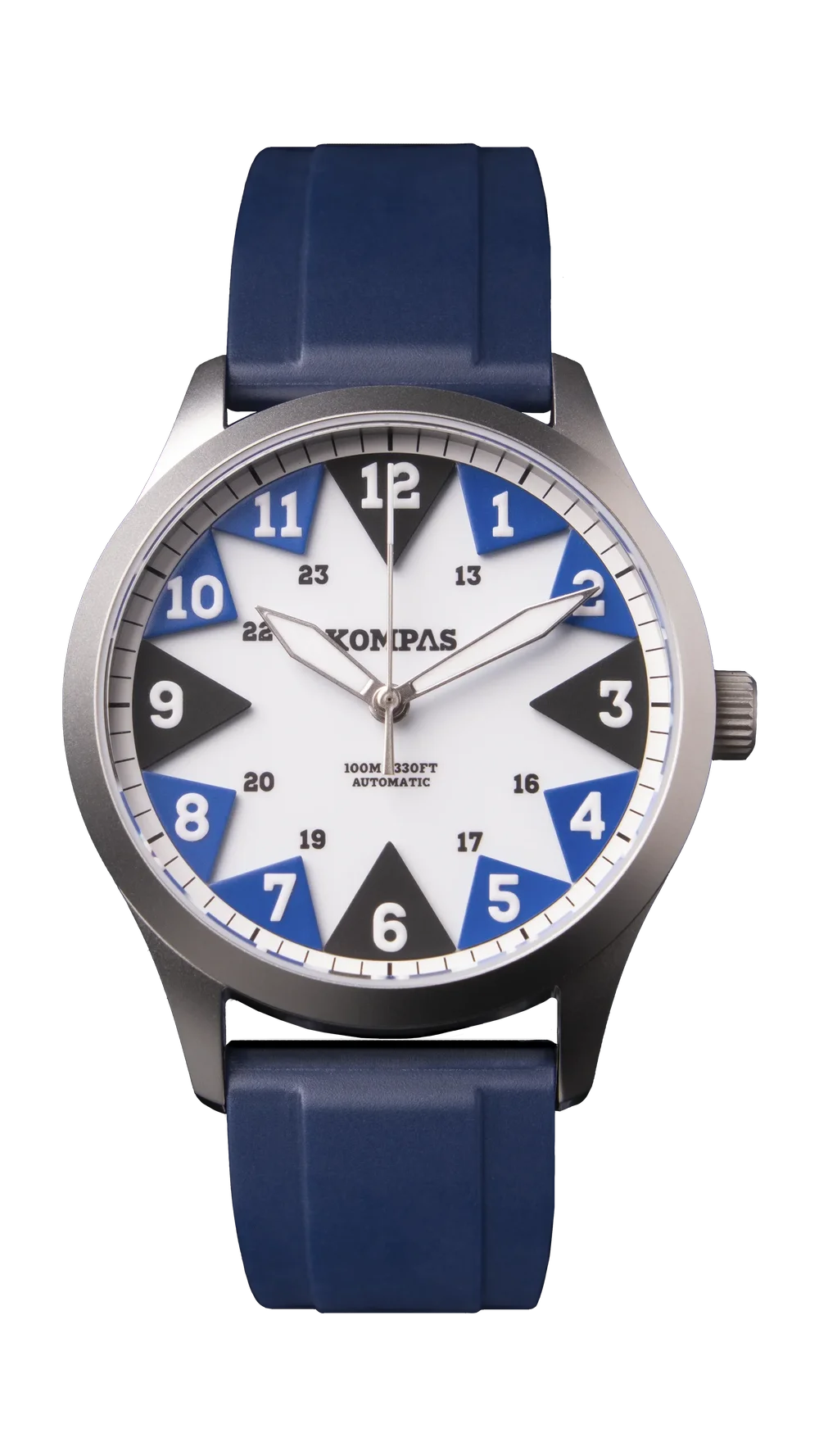
The KOMPAS take on the field watch
KOMPAS follows the field watch rules, with one twist: the dial.
A KOMPAS dial is built around 12 layered triangular segments, one for every five minutes. It is inspired by the colour-coded RAF sector clocks that hung in Fighter Command operations rooms during the Battle of Britain in 1940, where the minute hand's colour segment told plotters how old each piece of information on the table was. It makes the dial readable at a glance, and it gives the watch a story rooted in British history. You can read the full story on our history page.
The rest is pure field watch:
- 39 mm sandblasted stainless steel case, 46.5 mm lug to lug, 10.4 mm thick
- Sapphire crystal with anti-reflective coating on both sides
- Swiss Super-LumiNova® on the hands and markers
- Japanese Miyota 9039 automatic, time only, no date
- 100 m water resistance and a display caseback
- 20 mm lugs, with two quick-release straps in the box: rubber and nylon
KOMPAS costs £535 and comes in four directions: North (black), East (green), South (blue) and West (red). At the time of writing, all four directions (North, East, South and West) are in stock. Every KOMPAS is designed in Great Britain. Built to be worn, not kept in a drawer.
See the collection → · Full technical details →
Frequently asked questions
What is a field watch?
A field watch is a tough, legible, modestly sized watch with a clean, high-contrast dial, luminous hands and markers, a durable case and a simple strap. It grew out of the wristwatches soldiers wore in the First and Second World Wars.
What size is a field watch?
Most field watches are between 36 and 40 mm in diameter. KOMPAS is 39 mm with a 46.5 mm lug-to-lug length, which suits most wrists.
Can you wear a field watch every day?
Yes. That is what it is designed for. A field watch is light, legible and robust, and it works with a T-shirt, a suit or hiking boots.
Can you swim with a field watch?
It depends on the water resistance. Many modern field watches are rated to 100 m, which is suitable for swimming. KOMPAS is rated to 100 m. Always keep the crown pushed in.
Do field watches have a date?
Some do, but many leave it out to keep the dial clean. KOMPAS is time-only, using the Miyota 9039 movement.
What is the difference between a field watch and a pilot watch?
A pilot watch is usually larger, with an oversized crown and a cockpit-style dial. A field watch is smaller and simpler, designed to be worn anywhere.
