
An RAF sector clock watch is a wristwatch whose dial borrows the five-minute colour segments of the sector clocks used in RAF Fighter Command operations rooms during the Battle of Britain in 1940. To read a five-minute dial, read the hour as normal, then note which segment the minute hand is in: each segment is five minutes, and three make a quarter of an hour.
On the wall of every RAF Fighter Command operations room in 1940 hung a clock that looked unlike any other. Around its face ran a ring of coloured triangles, red, yellow and blue, each covering five minutes. It was not decoration. It was the tool that told everyone in the room how old each piece of information on the plotting table was, and it helped make sure no decision was taken on stale data.
That clock, usually called the RAF sector clock, is the inspiration for the KOMPAS dial, our own watch. This post explains where it came from, how it worked, and how to read a five-minute dial at a glance on your wrist.

Before 1940: colour-change clocks over London
The idea is older than the Battle of Britain. During the First World War, London came under attack from the air, first from Zeppelin airships and later from Gotha bombers. Defending a city against aircraft was a new problem, and it was mostly a problem of information: where were the raiders, which way were they heading, and how recent was that report?
In September 1915 the London Air Defence Area, or LADA, was formed. In August 1917 Major-General Edward Ashmore was appointed to command it, and he reorganised London's defences. Reports from ground observers were telephoned to a central office at Horse Guards, where operators marked each sighting on a large map table. The markers were colour-coded to match coloured sections on the face of a large clock, so anyone looking at the table could see at a glance which reports were fresh and which were older. With a sequence of fresh markers, they could also see which way a raid was moving.
These early "colour-change clocks" were introduced by the Royal Flying Corps in 1917. The principle was simple, and it lasted.
Between the wars: the system grows
Ashmore stayed involved in air defence after the war. In 1924 he organised experiments in Kent, with a control centre in the post office at Cranbrook receiving reports from observers. The following year, the Observer Corps was born. Through the 1930s the RAF combined these ideas with a new invention, radar, into what became known as the Dowding system, after Air Chief Marshal Hugh Dowding, head of Fighter Command.
1940: the sector clock in Fighter Command
By the summer of 1940, information flowed through Fighter Command in layers:
- Radar stations and the Observer Corps reported incoming aircraft.
- The filter room at Bentley Priory, Fighter Command's headquarters in north-west London, sorted radar reports into individual tracks.
- Group operations rooms took those tracks and directed their squadrons. No. 11 Group, which covered London and the south-east and handled most of the fighting, worked from an underground operations room at RAF Uxbridge, completed in August 1939.
- Sector stations, usually at one of the sector's airfields, talked directly to the pilots.
In each of these rooms, plotters stood around a large map table and moved counters and arrows as reports arrived by telephone. Above them hung the sector clock.
How the sector clock worked
The clock face carried triangular segments for every five minutes, alternating red, yellow and blue around the dial. When a report came in, the plotter looked at the clock and placed a marker in the colour of the segment the minute hand was pointing to.
The clever part was what happened next. When the minute hand moved into a new colour, plots of that colour from the previous cycle were cleared from the table, so the colour could be used again. Each colour came round every 15 minutes, so nothing on the table was ever more than 15 minutes old. A glance at the colours on the table told a controller how fresh each track was, and the order of the colours showed which way a raid was moving.
It was a mechanical solution to an information problem: a simple, shared rule that the whole room could follow under pressure without asking anyone.
Where to see one today
The No. 11 Group operations room at Uxbridge, now known as the Battle of Britain Bunker, is a Grade I listed building, and its colour-coded clock still hangs on the wall in its original position. The Bentley Priory Museum also displays an operations room clock. Both can be visited; check opening times before you go. Our history page tells more of the story.
From the operations room to the wrist
When we designed KOMPAS, we wanted a field watch dial that was easy to read and meant something. The sector clock gave us both. (If you are new to the category, what is a field watch? covers the basics.)
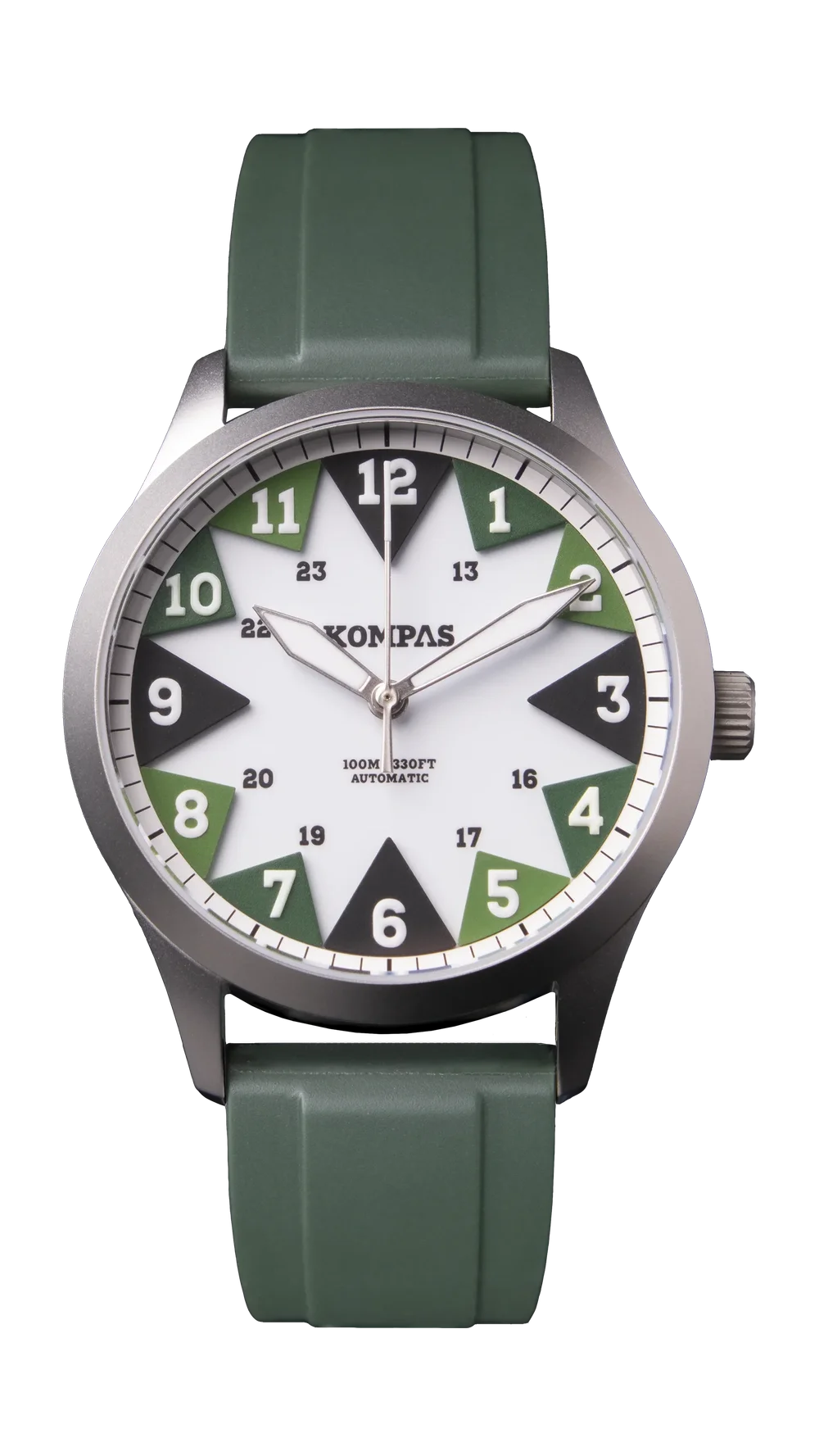
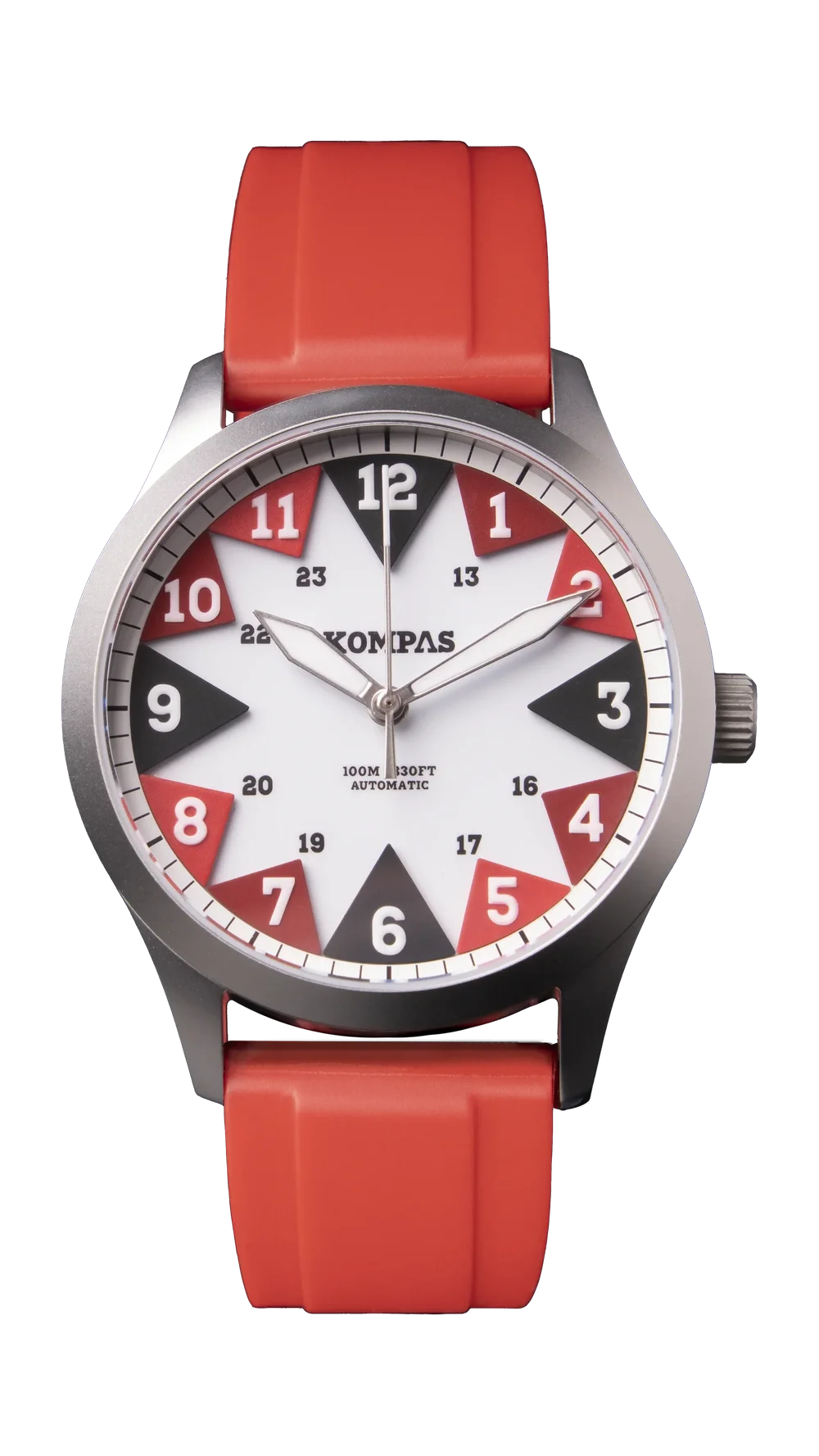
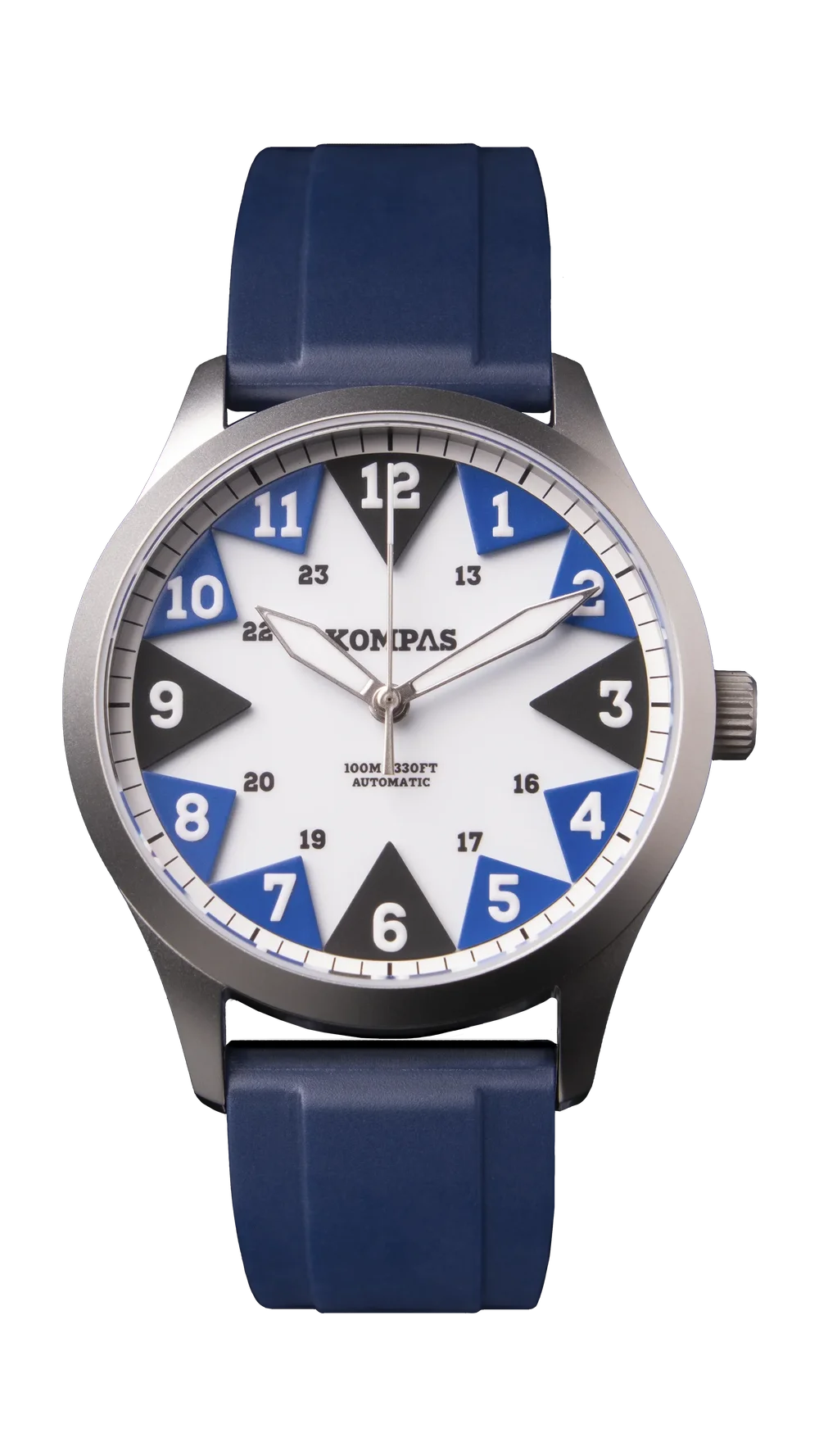
A KOMPAS dial carries 12 triangular segments, one for every five minutes, arranged around the dial just as they were on the operations room clocks. The segments are layered into the dial, which gives it depth. Under the sapphire crystal, with anti-reflective coating on both sides, the dial stays readable in bright sun; in the dark, the Swiss Super-LumiNova® takes over.
We call it an RAF sector clock watch because that is exactly what it is: a working wristwatch whose dial borrows its logic from those clocks.
How to read a 5-minute dial at a glance
You read a KOMPAS like any watch: hour hand for the hour, minute hand for the minutes. The segments simply make the minutes faster to read.
1. Read the hour
The short hand tells you the hour, exactly as on any watch.
2. Read the five-minute block
Each of the 12 segments covers five minutes. The segment the minute hand is in tells you the five-minute block straight away. Minute hand in the first segment after 12: between :00 and :05. In the seventh: between :30 and :35. You don't need to count individual minute marks.
3. Read the quarters
Three segments make a quarter of an hour. The 3, 6 and 9 o'clock positions mark quarter past, half past and quarter to, so a glance at how many segments the minute hand has covered tells you where you are in the hour.
4. Fine-tune if you need to
For the exact minute, look at where the minute hand sits within its segment. Near the start, it is the first minute or two of the block; near the end, it is about to tick into the next.
5. Time short intervals the plotters' way
The sector clock was, in effect, a timer. You can use a KOMPAS the same way. Note which segment the minute hand is in when you start something, a parking meter, a pot on the stove, a break between sets. Each segment that passes is five minutes. When three segments have passed, a quarter of an hour is up: the same 15 minutes after which a 1940 plot would have been cleared from the table.
6. Use the seconds hand for precision
The central seconds hand, driven by the Miyota 9039 at 28,800 vph, sweeps smoothly around the segments. Because the movement hacks, you can stop the seconds hand when you set the time and start it again exactly on the minute.
The rest of the watch
The dial is the story; the watch around it is a straightforward field watch.
- Case: 39 mm sandblasted stainless steel, 46.5 mm lug to lug, 10.4 mm thick, 20 mm lugs
- Movement: Japanese Miyota 9039 automatic, 24 jewels, 28,800 vph, about 42 hours of power reserve, hacking, hand-winding, no date
- Crystal: sapphire with anti-reflective coating on both sides
- Water resistance: 100 m
- Lume: Swiss Super-LumiNova®
- Caseback: display
- In the box: two quick-release straps, rubber and nylon, in a triangle presentation box
- Price and warranty: £535, with a 2-year international warranty
KOMPAS comes in four directions: North (black), East (green), South (blue) and West (red). At the time of writing, North and South are in stock; East and West are sold out, with a waitlist. Designed in Great Britain. See every detail on the technical page, browse the collection, or see how it compares in the best field watches under £600.
Frequently asked questions
What is an RAF sector clock?
It is the clock used in RAF Fighter Command operations rooms during the Second World War. Its face carried red, yellow and blue triangles for every five minutes. Plotters placed markers in the colour the minute hand pointed to, so everyone could see how old each report was.
Why did the RAF sector clock use red, yellow and blue?
Three colours of five minutes each gave a 15-minute cycle. When the minute hand entered a colour, the old plots of that colour were removed, so nothing on the plotting table was older than 15 minutes.
When were colour-change clocks first used?
During the First World War. The Royal Flying Corps introduced them in 1917, when Major-General Edward Ashmore was reorganising the London Air Defence Area. Reports were marked on a map table at Horse Guards in colours matching the clock face.
Where can I see an original RAF sector clock?
The Battle of Britain Bunker at RAF Uxbridge still has its colour-coded clock on the wall in its original position. The Bentley Priory Museum also displays an operations room clock. Check opening times before visiting.
How do you read a KOMPAS dial?
Read the hour hand as normal. Each of the 12 triangular segments covers five minutes, so the segment the minute hand is in gives you the five-minute block at a glance. Three segments make a quarter of an hour.
Is KOMPAS an official RAF watch?
No. KOMPAS is an independent watch designed in Great Britain. Its dial is inspired by the historic RAF sector clock, but it is not an RAF-issued or RAF-endorsed watch.
