
Updated · By Adventure Man
A field watch is small, simple and legible for everyday wear; a pilot watch is larger, with big numerals and a big crown made for the cockpit; a dive watch adds a unidirectional rotating bezel and high water resistance for timing dives. For most people who want one watch for everything, a field watch is the easiest to live with.
All three started with a job to do: one for the soldier, one for the aviator, one for the diver. Today most of us wear them to the office, at the weekend and on holiday, so the real question isn't which one is best. It is which one suits the way you live.

Field watch vs pilot vs dive watch at a glance
| Field watch | Pilot watch | Dive watch | |
|---|---|---|---|
| Built for | Soldiers on the ground | Aviators in the cockpit | Divers underwater |
| Typical size | 36-40 mm | 40-46 mm | 40-44 mm |
| Typical thickness | Slim to medium | Medium | Medium to thick |
| Signature feature | Maximum legibility, simple dial | Large numerals, big crown | Rotating timing bezel |
| Bezel | Usually fixed and plain | Usually fixed | Unidirectional rotating |
| Water resistance | Everyday to swimming (50-100 m+) | Usually moderate | High, often 200 m+ |
| Lume | Hands and markers | Hands and numerals | Strong, often on the bezel too |
| Feel on the wrist | Light, unobtrusive | Large, statement | Chunky, sporty |
| Best for | Every day, everywhere | Travel and bold style | Water and sport |
These are typical traits, not rules. Plenty of watches mix them, and the lines between the categories have blurred over the decades.
The field watch
Where it came from
The field watch was born in the First World War, when soldiers swapped pocket watches for small, tough watches strapped to the wrist. By the Second World War, armies issued standardised field watches with black dials, clear numerals, luminous hands and robust cases. Our guide what is a field watch? covers the full story.
What defines it
Clarity and toughness, without fuss. A clean, high-contrast dial; lume on the hands and markers; a modest case, usually 36-40 mm; a sapphire or tough crystal; and a simple strap in nylon, canvas or rubber. It is the smallest and simplest of the three, which is why it is so easy to wear.
How it wears
Light and unobtrusive. A field watch slides under a shirt cuff and works with a T-shirt, a suit or hiking boots. It rarely feels like too much watch.
Choose a field watch if you want one watch that does everything, every day.
The pilot watch
Where it came from
Early aviators needed a watch they could read in a vibrating, poorly lit cockpit, often while wearing thick gloves. That led to oversized cases, large numerals and big crowns. The classic German Flieger designs of the Second World War, often with a triangle at 12 o'clock to help orientation, still shape pilot watches today. Many pilot watches also add a slide-rule bezel or a GMT hand for time zones.
What defines it
Big, bold legibility. Large Arabic numerals, long hands, a matt black dial, and a crown that can be gripped with gloves on. Water resistance is often moderate, because a cockpit isn't wet.
How it wears
Large. Many pilot watches are 40 mm and above, some much more, with long lugs. On a bigger wrist they look superb. On a smaller wrist they can overhang and feel like a lot of watch.
Choose a pilot watch if you like a bold look, travel often, and have the wrist for it.
The dive watch
Where it came from
Recreational scuba diving took off in the 1950s, and divers needed to know how long they had been underwater. The answer was a rotating bezel: line the zero marker up with the minute hand at the start of a dive and read elapsed time directly. The bezel turns one way only, so a knock can only shorten the apparent time left, never extend it. There is even an international standard for divers' watches, ISO 6425, which sets requirements for water resistance, legibility in the dark and a way to keep track of dive time.
"designed to withstand diving in water at depths of at least 100 m"
Scope of ISO 6425:2018, Horology: Divers’ watches
So 100 m is where a certified divers' watch starts, and the standard also asks for a dive-time indicator that is visible in darkness. A high depth rating on its own does not make a watch an ISO 6425 diver.
What defines it
A unidirectional rotating bezel, high water resistance (often 200 m or more), a screw-down crown, very strong lume and a robust case. Dive watches are built to be overspecified for daily life.
How it wears
Sporty and substantial. The bezel and extra case thickness needed for water resistance make dive watches the chunkiest of the three, and they often come on heavy steel bracelets.
Choose a dive watch if you spend real time in or under water, or simply love the look.
How to choose: five practical questions
1. What will you actually do with it?
Be honest. If your watch goes to the office, the gym, the pub and on holiday, a field watch covers all of it. If you scuba dive, get a proper dive watch. If you fly or travel constantly, a pilot watch with a GMT function might earn its place.
2. What is your wrist size?
This often decides it. Field watches suit almost every wrist. Pilot watches suit larger wrists best. Dive watches sit in between, but the extra thickness counts. Measure the flat top of your wrist and compare it to the watch's lug-to-lug length.
For scale: in the US Army's 2012 anthropometric survey, the middle 90% of men had wrists between 16.2 and 19.1 cm, and the middle 90% of women between 14.2 and 16.8 cm (ANSUR II report, 2014). If yours is towards the lower end, our guide to field watches for small wrists ranks the options by lug-to-lug.
3. How much water resistance do you need?
For rain and washing, 50 m is fine. For swimming and snorkelling, choose 100 m or more. For scuba, choose a watch designed and rated for diving.
Everyday ratings come under a different standard, ISO 22810:2010, which sets the requirements and test methods for water-resistant watches. Divers' watches have their own rules in ISO 6425.
4. Do you want one watch or several?
If you are buying one watch to wear every day, the field watch is the safest all-rounder. If you already own a field watch, a pilot or dive watch is a natural second.
5. Does it have a story you like?
Tool watches are as much about where they came from as what they do. Pick the history that means something to you.
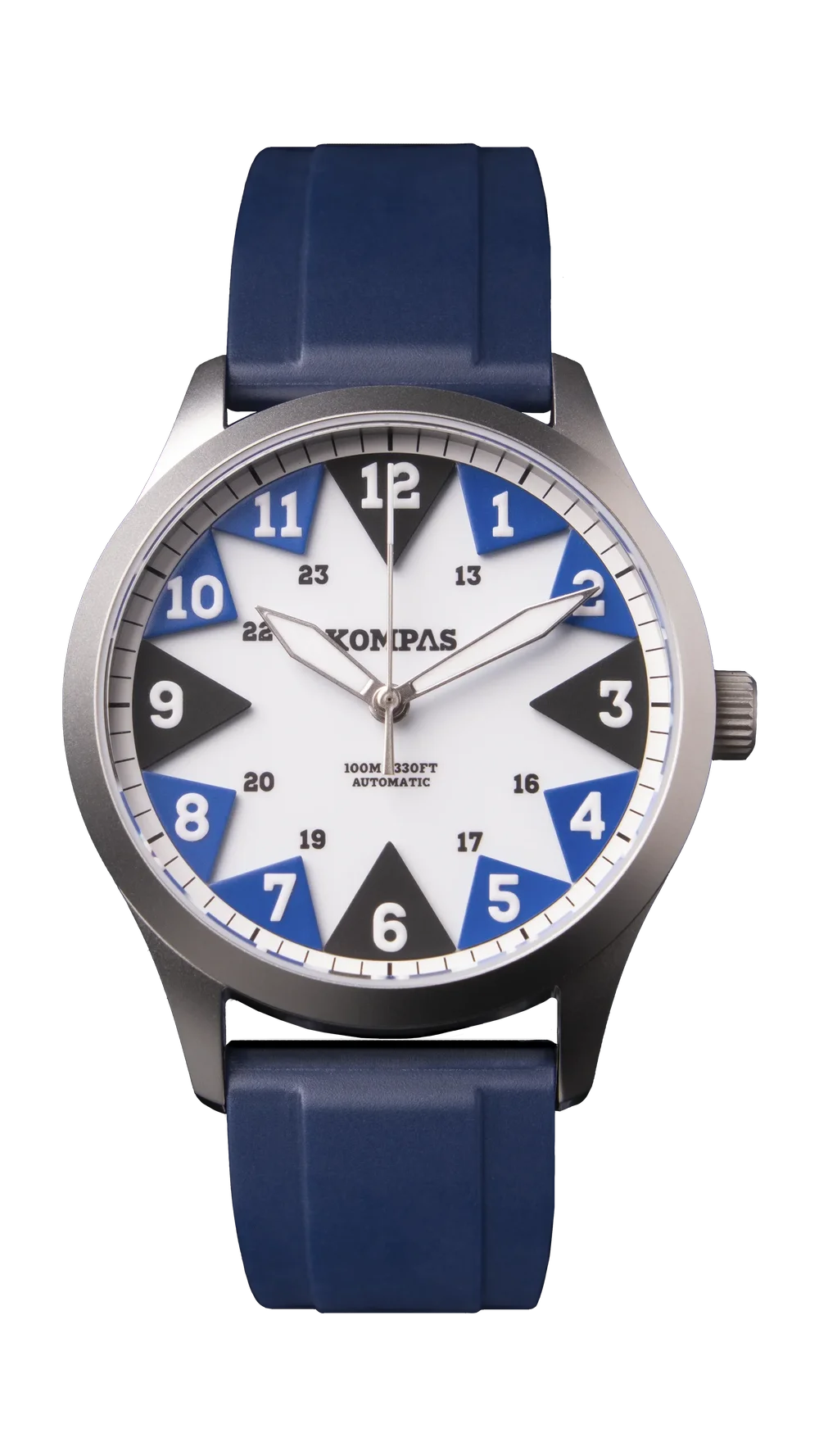
Where KOMPAS sits
KOMPAS is a field watch at heart, with a dial that borrows from aviation history.
The case, crystal and movement follow field watch rules: 39 mm sandblasted stainless steel, 46.5 mm lug to lug and 10.4 mm thick; sapphire crystal with anti-reflective coating on both sides; Swiss Super-LumiNova®; a time-only Miyota 9039 automatic; and 100 m water resistance, so swimming is no problem.
The dial is where the aviation story comes in. Its 12 layered triangular segments, one for every five minutes, are inspired by the colour-coded RAF sector clocks of Fighter Command operations rooms during the Battle of Britain in 1940. Plotters used those clocks to judge how old each report on the table was. On a KOMPAS, the same five-minute segments let you read the time, and roughly time short intervals, at a glance. We explain how in RAF sector clock watch: how to read a 5-minute dial.
"The red, yellow and blue triangles on the clock face each span five minutes."
RAF Museum, Sector Room Clock (Replica)
Field watch practicality, with a story that connects to the people who flew and the people on the ground who directed them. Our history page tells it in full.
Two quick-release straps come in the box, rubber and nylon, so the same watch goes from a swim to dinner. KOMPAS is £535. See North in black or South in blue, both in stock at the time of writing, browse all four directions on the watches page, or check the technical details.
Frequently asked questions
What is the main difference between a field watch, a pilot watch and a dive watch?
A field watch is small, simple and legible for everyday use. A pilot watch is larger, with big numerals and a big crown for the cockpit. A dive watch adds a unidirectional rotating bezel and high water resistance for timing dives.
Which is the best everyday watch: field, pilot or dive?
For most people, a field watch. It is the lightest and most versatile of the three and suits almost any wrist and outfit.
Can I swim with a field watch?
Yes, if it is rated for it. Look for 100 m or more. KOMPAS is rated to 100 m, which is suitable for swimming. For scuba diving, use a purpose-built dive watch.
Are pilot watches too big for small wrists?
Often, yes. Many pilot watches are 40 mm or larger with long lugs. If you have a smaller wrist, check the lug-to-lug length against the width of the top of your wrist before you buy.
Is KOMPAS a field watch or a pilot watch?
KOMPAS is a field watch. Its 39 mm case, legible dial, lume and 100 m water resistance follow field watch rules. Its dial is inspired by the RAF sector clocks used in Fighter Command operations rooms during the Battle of Britain.
